Section 4.5 Investigation 1.9: Kissing the Right Way (cont.)
The normal approximation can also be used to approximate confidence intervals.
Exercises 4.5.1 Interval of plausible values based on Central Limit Theorem
Recall the study published in Nature that found 64.5% of 124 kissing couples leaned right to kiss (Investigation 1.6). We previously used simulation and the binomial distribution to determine which values were plausible for the underlying probability that a kissing couple leans right (\(\pi\)). In particular, we found 0.5 and 0.74 were not plausible values for \(\pi\) but 0.6667 was. The 95% Clopper-Pearson Binomial confidence interval was (0.554, 0.729). Now you will consider applying the normal model as another method for producing confidence intervals for this parameter.
When you do not have a particular value to be tested for the process probability, it’s reasonable to use the sample proportion in checking the sample size condition for the CLT. (This is equivalent to making sure there are at least 10 successes and at least 10 failures in the sample.)
2. Describe Distribution of Sample Proportion.
3. Estimate Standard Deviation - Method.
4. Estimate Standard Deviation - Calculation.
Calculate this estimate:
Definition.
The standard error of the sample proportion, \(SE(\hat{p})\text{,}\) is an estimate for the standard deviation of \(\hat{p}\) (i.e., \(SD(\hat{p})\)) based on the sample data, found by substituting the sample proportion for \(\pi\text{:}\)
\begin{equation*}
SE(\hat{p}) = \sqrt{\frac{\hat{p}(1-\hat{p})}{n}}
\end{equation*}
5. Find Largest Plausible Distance.
Now consider calculating a 95% confidence interval for the process probability \(\pi\) based on the observed sample proportion \(\hat{p}\text{.}\) What’s the largest distance you expect to see a sample proportion \(\hat{p}\) fall away from the underlying process probability \(\pi\text{?}\) [Hint: Assuming a normal distribution … 95% …]
Largest plausible distance =
6. Calculate Confidence Interval.
Use the distance from the previous question and the observed sample proportion of \(\hat{p} = 0.645\) to determine an interval of plausible values for \(\pi\text{,}\) the probability that a kissing couple leans to the right.
(Lower bound: , Upper bound: )
An approximate 95% confidence interval for the process probability based on the normal distribution would be \(\hat{p} \pm 2\sqrt{\hat{p}(1-\hat{p})/n}\text{.}\) That is, this interval extends two standard deviations on each side of the sample proportion. We know that for the normal distribution roughly 95% of observations (here sample proportions) fall within 2 SDs of the mean (here the unknown process probability), so this method will "capture" the process probability for roughly 95% of samples.
However, we should admit that the multiplier of 2 is a bit of a simplification. So how do we find a more precise value of the multiplier to use, including for values other than 95%?
Definition.
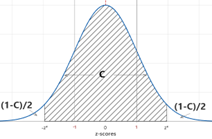
Note: We use the symbol \(z^*\) to distinguish this value, found based on the confidence level, from \(z_0\text{,}\) the observed \(z\)-score for the data.
Technology Detour — Finding Percentiles from the Standard Normal Distribution.
Use technology to more precisely determine the number of standard deviations that capture the middle 95% of the normal distribution with mean = 0 and standard deviation = 1. [Hint: In other words, how many standard deviations do you need to go on each side of zero to capture the middle 95% of the standard normal distribution?] Keep in mind that the \(z\)-value corresponding to probability \(C\) in the middle of the distribution, also corresponds to having probability \((1-C)/2\) in each tail.
7. Find the 95% Critical Value.
Hint 1. Normal Probability Calculator
In Normal Probability Calculator applet:
-
You can leave the mean set to zero and the standard deviation to 1 and the variable is "z-scores."
-
Check the box next to the first \(<\) sign and specify the probability value to correspond to the lower tail probability of interest: \((1-C)/2\text{.}\) Press Enter/Return and it will display the negative \(z^*\)-value.
For 95% confidence, use probability 0.025 in the lower tail (or 0.975 for upper tail).
Hint 2. R/Sage Instructions
The
iscaminvnorm function takes the following inputs:
-
prob1= probability of interest -
mean= the mean of the normal distribution (default = 0) -
sd= the standard deviation of the normal distribution (default = 1) -
direction= whether the probability of interest was in the lower tail ("below"), upper tail ("above"), both tails ("outside"), or in the middle of the distribution ("between")
Hint 3. JMP Instructions
In JMP using the Distribution Calculator in the ISCAM Journal File:
-
From the Distribution pull-down menu, select Normal (at the top of the list)
-
Specify the values for the mean (0) and standard deviation (1)
-
Change the Type of Calculation to Input probability and calculate quantiles
-
Select Central Probability and specify the confidence level (e.g., 0.95)
-
Press Enter/Return.
8. Compare to 90% Critical Value.
Find the critical value for a 90% confidence interval. Is it larger or smaller than with 95% confidence? Why does this make sense?
-
Smaller
-
The same
-
Larger
One Sample \(z\)-Confidence Interval (Wald Interval) for \(\pi\).
When we have at least 10 successes and at least 10 failures in the sample, an approximate confidence interval for \(\pi\) is given by:
\begin{equation*}
\hat{p} \pm z^* \sqrt{\frac{\hat{p}(1-\hat{p})}{n}}
\end{equation*}
where \(z^*\) corresponds to the confidence level.
9. Identify Midpoint and Width.
10. Effect of Confidence Level on Width.
11. Effect of Sample Size on Width.
Definition.
The half-width of a confidence interval is also referred to as the margin of error.
So the above interval formula is of the common form: statistic \(\pm\) margin of error, where margin of error = critical value \(\times\) standard error of statistic. Here, margin of error = \(z^* \sqrt{\hat{p}(1-\hat{p})/n}\text{.}\)
Although 95% is the most common confidence level, a few other confidence levels and their corresponding critical values are shown in the table below.
| Confidence level | 90% | 95% | 99% | 99.9% |
|---|---|---|---|---|
| Critical value \(z^*\) | 1.645 | 1.960 | 2.576 | 3.291 |
12. Calculate 90% Confidence Interval.
13. Compare Interval Midpoints.
How does the midpoint of the 90% confidence interval compare to the midpoint of the 95% confidence interval?
The 90% interval midpoint is:
-
Larger
-
Not quite. Both intervals are centered at the same sample proportion.
-
Smaller
-
Not quite. Both intervals are centered at the same sample proportion.
-
Equal
-
Correct! Both intervals have the same midpoint (the sample proportion).
14. Compare Interval Widths.
How does the width of the 90% confidence interval compare to the width of the 95% confidence interval?
The 90% interval width is:
-
Larger
-
Not quite. Lower confidence level means narrower interval.
-
Smaller
-
Correct! The 90% interval is narrower because we use a smaller critical value (1.645 vs 1.96).
-
Equal
-
Not quite. Different confidence levels produce different widths.
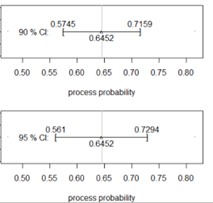
Technology Detour — One Proportion z-Confidence Intervals.
15. One Proportion z-interval with Technology.
Hint 1. R/Sage Instructions
Use the
iscamonepropztest function to calculate the z-confidence interval. The function takes the following inputs:
-
n= sample size -
hypothesized= hypothesized value (optional, for hypothesis tests) -
alternative= "greater", "less", or "two.sided" (optional, for hypothesis tests) -
conf.level= confidence level (as percentage or decimal)
If you don’t specify a hypothesized value and alternative, be sure to label the confidence level.
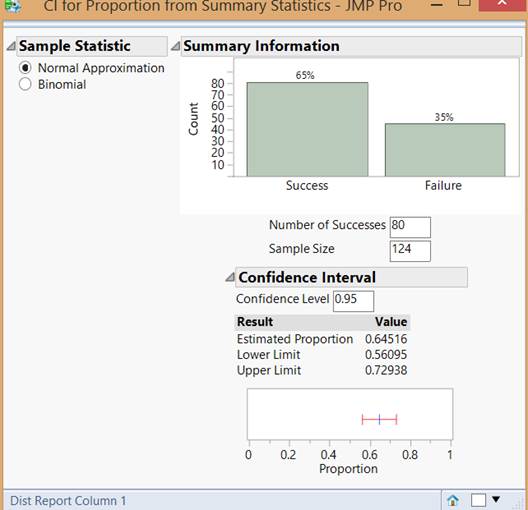
Hint 2. JMP Instructions
-
Open the ISCAM Journal file and select Confidence Interval for One Proportion
-
Specify Raw Data (column of outcomes) or Summary Stats
-
With Summary Stats, keep the radio button set to Normal Approximation
-
Enter the number of successes (80) and sample size (124)
-
Set the confidence level to 90%
The output will show the 90% \(z\)-confidence interval.
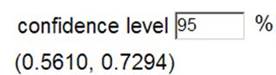
Hint 3. Theory-Based Inference Applet Instructions
Using the Theory-Based Inference applet:
-
Keep the pull-down menu set to One proportion.
-
Specify the sample size \(n\) = 124 and either the count (80) or the sample proportion (0.645).
-
Press Calculate.
-
Check the box for Confidence interval
-
Change the confidence level to 90%
-
Press the Calculate CI button
The applet will display the 90% \(z\)-confidence interval.

16. Compare to Exact Binomial Intervals.
How do the widths of the \(z\)-intervals compare to the Exact Binomial Confidence Intervals reported by R?
-
90 percent confidence interval:
(0.5684, 0.7166) -
95 percent confidence interval:
(0.5542, 0.7290)
Hint.
Sample Size Determination.
Suppose you are planning your own study about kissing couples. Before you collect the data, you know you would like the margin of error to be at most 3 percentage points and that you will use a 95% confidence level. Use this information to determine the sample size necessary for your study.
[This is a very common question asked of statisticians. Think about how to determine this using the \(z\)-interval formula. What information do you know? What information are you looking for?]
17. Approach 1: Using Previous Study.
18. Approach 2: Conservative Estimate.
19. Compare Sample Size Approaches.
We can solve for \(n\) by inverting the formula for the margin of error, assuming a value for \(\pi\text{.}\) The largest value for the margin of error occurs when \(\pi = 0.50\text{,}\) so that value can be used for a conservative estimate of the necessary sample size. You should always round your value up to the next integer to also ensure the margin of error won’t exceed the specification. Notice that this calculation is much more difficult with a binomial confidence interval which does not have a simple formula to manipulate.
Subsection 4.5.2 Practice Problem 1.9A
Recall from Practice Problem 1.8B that a student wanted to assess whether her dog Muffin tends to chase her blue ball and her red ball equally often when they are rolled at the same time. The student rolled both balls a total of 96 times, each time keeping track of which ball Muffin chased. The student found that Muffin chased the blue ball 52 times and the red ball 44 times. We arbitrarily decided to treat the blue ball as "success."
Checkpoint 4.5.6. Check Validity of \(z\)-procedures.
Is using theory-based \(z\)-procedures valid in this study? How are you deciding?
Checkpoint 4.5.7. Calculate 95% Confidence Interval.
Determine and interpret a 95% \(z\)-confidence interval.
Checkpoint 4.5.8. Compare Margins of Error.
Report the margin of error of your interval. Determine and compare to the margin of error change if with a 99% confidence level.
Checkpoint 4.5.9. Determine Required Sample Size.
What would be the necessary sample size if we wanted a margin of error of 0.01 for a confidence level of 95%? Explain how you are finding this.
Subsection 4.5.3 Practice Problem 1.9B
Checkpoint 4.5.10. Understanding Confidence Intervals.
In an actual study, how do you know whether your interval actually contains the value of the unknown parameter?
Checkpoint 4.5.11. Standard Deviation vs Standard Error.
What is the distinction between standard deviation and standard error?
Reconsider Muffin from Practice Problem 1.8B and suppose our confidence interval is (0.2689, 0.4811). For each statement below, determine whether it is a valid or invalid interpretation of this confidence interval.
Checkpoint 4.5.12. Statement 1.
You are 95% confident that the interval (0.2689, 0.4811) contains the sample proportion of blue balls chased by Muffin.
-
Valid
-
Incorrect. We know the sample proportion exactly; there’s no need for a confidence interval for it. The confidence interval is for the parameter (the true probability), not the sample proportion.
-
Invalid
-
Correct! We know the sample proportion exactly; there’s no need for a confidence interval for it. The confidence interval is for the parameter (the true probability), not the sample proportion.
Checkpoint 4.5.13. Statement 2.
There is a 95% chance that the interval (0.2689, 0.4811) captures the probability Muffin chasing the blue ball.
-
Valid
-
Incorrect. This makes it sound like the parameter is random, when it’s actually fixed. The interval is what’s random. Once we’ve constructed this specific interval, it either contains the parameter or it doesn’t.
-
Invalid
-
Correct! This makes it sound like the parameter is random, when it’s actually fixed. The interval is what’s random. Once we’ve constructed this specific interval, it either contains the parameter or it doesn’t.
Checkpoint 4.5.14. Statement 3.
95% of the time the interval (0.2689, 0.4811) contains the probability of Muffin chasing the blue ball.
-
Valid
-
Incorrect. This specific interval is fixed; it doesn’t change. The correct interpretation is about the procedure (95% of intervals constructed this way contain the parameter), not this specific interval.
-
Invalid
-
Correct! This specific interval is fixed; it doesn’t change. The correct interpretation is about the procedure (95% of intervals constructed this way contain the parameter), not this specific interval.
Checkpoint 4.5.15. Statement 4.
In the long run, 95% of sample proportions fall in between 0.2689 and 0.4811.
-
Valid
-
Incorrect. This confuses the confidence interval for the parameter with the distribution of sample proportions. The confidence interval tells us about plausible values for the parameter, not where sample proportions fall.
-
Invalid
-
Correct! This confuses the confidence interval for the parameter with the distribution of sample proportions. The confidence interval tells us about plausible values for the parameter, not where sample proportions fall.
Checkpoint 4.5.16. Statement 5.
If the null hypothesis is true, there is a 95% chance the interval contains the parameter.
-
Valid
-
Incorrect. Confidence intervals don’t depend on whether a null hypothesis is true or not. The confidence level comes from the sampling distribution, not from any hypothesis.
-
Invalid
-
Correct! Confidence intervals don’t depend on whether a null hypothesis is true or not. The confidence level comes from the sampling distribution, not from any hypothesis.
Checkpoint 4.5.17. Statement 6.
I am 95% confident that Muffin chases the blue ball between 27% and 48% of the time.
-
Valid
-
Correct! This correctly expresses confidence about the parameter (the underlying probability/long-run proportion). This is a proper interpretation of a confidence interval.
-
Invalid
-
Incorrect. This is actually a valid interpretation because it correctly expresses confidence about the parameter (the underlying probability/long-run proportion).
You have attempted of activities on this page.

