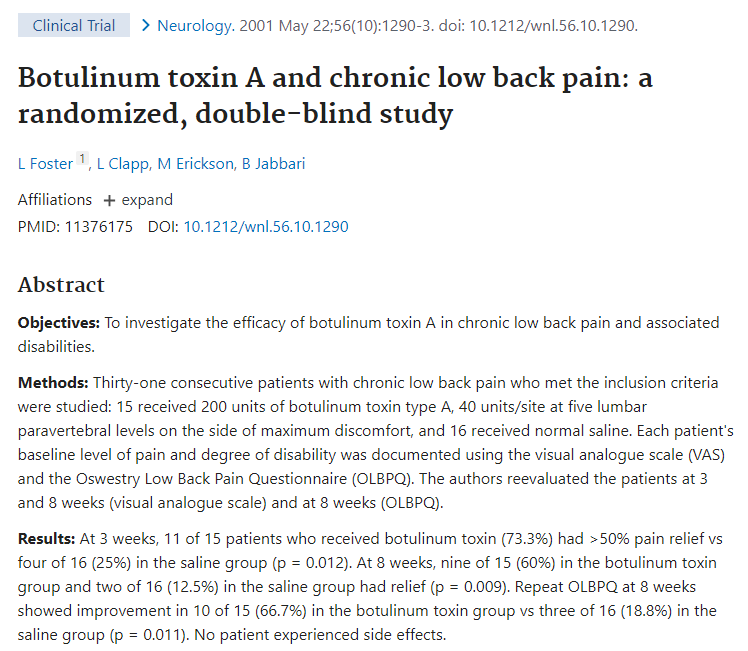
A 2001 study (Foster, Clapp, Erickson, & Jabbari, Neurology, "Botulinum toxin A and chronic low back pain: A randomized, double-blind study") examined the efficacy of botulinum A (botox, used in various cosmetic and medical procedures) in lower back pain. An excerpt from the journal article follows:
Thirty-one consecutive patients with chronic low back pain who met the inclusion criteria were studied: 15 received 200 units of botulinum toxin type A, 40 units/site at five lumbar paravertebral levels on the side of maximum discomfort, and 16 received normal saline. Each patient’s baseline level of pain and degree of disability was documented using the visual analogue scale (VAS) and the Oswestry Low Back Pain Questionnaire (OLBPQ). The authors reevaluated the patients at 3 and 8 weeks (visual analogue scale) and at 8 weeks (OLBPQ).
At 3 weeks, 11 of 15 patients who received botulinum toxin (73.3%) had >50% pain relief vs four of 16 (25%) in the saline group (p = 0.012). At 8 weeks, nine of 15 (60%) in the botulinum toxin group and two of 16 (12.5%) in the saline group had relief (p = 0.009). Repeat OLBPQ at 8 weeks showed improvement in 10 of 15 (66.7%) in the botulinum toxin group vs three of 16 (18.8%) in the saline group (p = 0.011). No patient experienced side effects.
Explain why it was important to use a comparison ("control") group in this study (rather than simply give botox to all subjects and then measure whether they had experienced pain relief at the end of the study).
To guard against other things changing during the same time period (e.g., back pain just going away over time). We need that to be the same in both groups so that we can further isolate the effects of the botox.
Explain why standardized measurements of pain were used. Do you think the researchers who analyze the effectiveness of Botox should be the ones administering the measurement scales?
To ensure the response variable is measured consistently and without bias (so person taking the measurements also should not know which treatment the patient received). It would be best for someone other than the researchers to administer the measurement scales.
A randomized, comparative, double-blind experiment includes two or more groups being compared, random assignment of "subjects" to groups, and double-blindness (neither the subjects nor the evaluators of the response variable knows which treatment group the subject is in, to guard against the placebo effect and other subjective biases). These types of studies, brought to the forefront of scientific attention by R.A. Fisher (1935), are considered the gold standard for determining cause-and-effect relationships between variables.
Keep in mind, it is not always feasible to design such a study. You also need to be cautious of the Hawthorne effect – people involved in a study sometimes act differently just by virtue of being in a study – and other issues of realism and feasibility, such as:
For each of the following research questions, describe how you would design an observational study to address the question and how you would design an experiment. In each case, identify which study you feel is more appropriate. In particular, are there any ethical or logistical issues that might prevent you from carrying out the suggested experiment?
Researchers conducted a randomized, double-blind trial to determine whether taking large amounts of Vitamin E protects against prostate cancer (Journal of the National Cancer Institute, 1998). To study this question, they enrolled 29,133 Finnish men, all smokers, between the ages of 50 and 69. The men were divided into two groups: One group took vitamin E and a second group took a placebo. The researchers followed all the men for eight years and then determined whether they had developed prostate cancer. They found that participants taking vitamin E were significantly less likely to develop prostate cancer.
Based on this report, is it reasonable to conclude that taking vitamin E causes a reduction in the probability of developing prostate cancer? Explain your reasoning.
In a study published in the July 2003 issue of the journal Psychosomatic Medicine, researchers reported that people who tend to think positive thoughts catch a cold less often than those who tend to think negative thoughts. The scientists recruited 334 initially healthy male and female volunteers aged 18 to 54 years through advertisements in the Pittsburgh area, and they first interviewed them over a two-week period to gauge their emotional state, eventually assigning them a numerical score for positive emotions and a numerical score for negative emotions. Then the subjects were quarantined before the researchers injected rhinovirus, the germ that causes colds, into each subject’s nose. The subjects were then monitored for five days for the development of cold-like symptoms. Subjects scoring in the bottom third for positive emotions were three times more likely to catch a cold than those scoring the top third for positive emotions.
According to the above definitions, is this an observational study or a randomized experiment? Would it be valid to draw a cause-and-effect conclusion from their results? Explain.