Statistic: Odds ratio (typically set up to be larger than one) = \(\frac{A \times D}{B \times C}\) or equivalently \(\frac{\text{odds}_1}{\text{odds}_2} = \frac{\frac{\hat{p}_1}{1-\hat{p}_1}}{\frac{\hat{p}_2}{1-\hat{p}_2}}\)
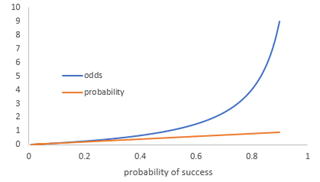
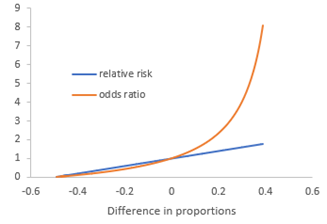
The graphs below show how (a) the probability of success and odds of success are related and (b) how relative risk and odds ratios are similar when the difference in proportions is small. Also note that when the difference in proportions is zero, the relative risk and the odds ratio are both one.
The table below demonstrates the invariance property of the odds ratio for Investigation 3.9. Notice that the odds ratio remains constant at 9.385 regardless of how we set up the comparison, while the relative risk changes depending on the setup.