Subsection 6.7 Chapter 1 Appendix: Stratified Random Sampling
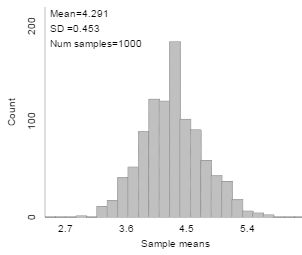
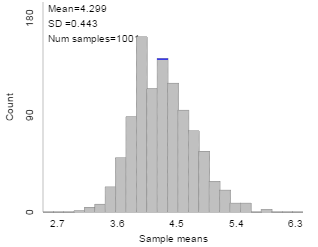
Another way to reduce variability without taking larger samples is to take even more care in our sampling. For example, a stratified sampling method splits the population into homogenous groups first, and then samples a preset proportion from each subgroup. In the Gettysburg Address example, if we suspect nouns tend to be longer than non-nouns but worry that with only 16% nouns in the population we could easily end up with a sample without nouns, we can force the sample to contain 3 nouns and 17 non-nouns. This method will again be unbiased and if we stratify on a useful variable, we should find even less random sampling variability. Below we see in this case that in stratified random samples of size 20, there is a little bit less variability in the distribution of sample means (though not much here).
You have attempted of activities on this page.

