Initially, you wrote all your code in the main method, but now we are using lots of methods. Why have multiple methods instead of just one? Procedural Abstraction allows us to name a block of code as a method and call it whenever we need it, abstracting away the details of how it works. This serves to organize our code by function and reduce its complexity and reduce the repetition of code. In addition, it helps with debugging and maintenance since changes to that block of code only need to happen in one place. Here are some of the main reasons to use multiple methods in your programs:
Organization and Reducing Complexity: organize your program into small sections of code by function to reduce its complexity. Divide a problem into subproblems to solve it a piece at a time.
public void chorus()
{
      System.out.println("With a knick knack paddy whack, give a dog a bone.");
      System.out.println("This old man came rolling home.");
}
Subsection6.3.1Parameters
You may have noticed more repetition in the song above. What about the lines of each verse? Notice that every word is repeated except the last ones that include a number and a rhyme such as one/thumb and two/shoe.
System.out.println("This old man, he played one.");
System.out.println("He played knick knack on my thumb.");
...
System.out.println("This old man, he played two.");
System.out.println("He played knick knack on my shoe.");
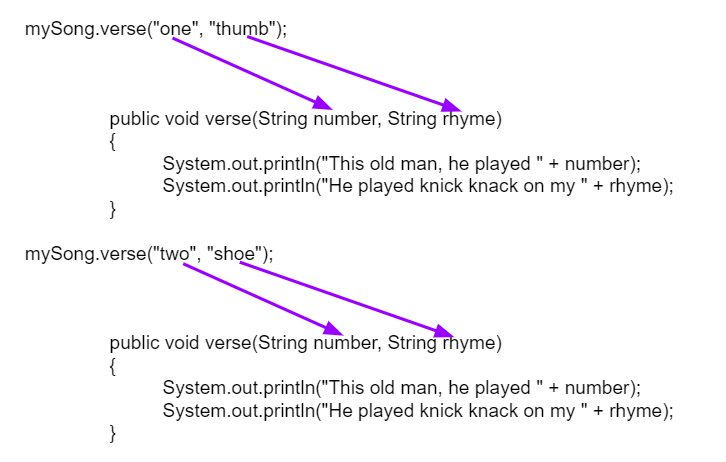
We can make methods even more powerful and more abstract by giving them parameters for data that they need to do their job. We can make a method called verse that takes the number and the rhyme to print out any verse!
public void verse(String number, String rhyme)
{
   System.out.println("This old man, he played " + number);
   System.out.println("He played knick knack on my " + rhyme);
}
Checkpoint6.3.1.
Run the following code to see the song This Old Man print out using the verse and chorus methods. You can also see this code run in the Java visualizer by clicking on the Show Code Lens button below. Can you add verse three with the rhyme “knee”? Can you add verse four with the rhyme “door”? How many verses do you know?
When you create your own method, the variables you define for it in the method header are called formal parameters. When you call the method to do its job, you give or pass in arguments or actual parameters to it that are then saved in these local parameter variables.
When a method is called, the right method definition is found by checking the method signature or header at the top of the method definition to match the method name, the number of arguments, the data types for the arguments and the return type.
Java uses Call by Value when it passes arguments to methods. This means that a copy of the value in the argument is saved in the parameter variable. If the parameter variable changes its value inside the method, the original value outside the method is not changed.
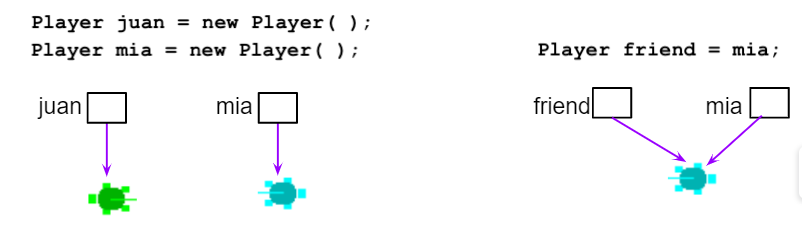
If you pass in an argument that holds a reference to an object, like a String or Player object, a copy of this reference is passed in and saved in the parameter variable. The formal parameter and the actual parameter (argument) are then aliases, both refering to the same object. Java was designed this way to avoid copying large objects from method to method. Remember when we discussed reference aliases with objects who are set equal to one another.
(Advanced topics warning): Although String objects are not mutable, the classes that you create will have mutable objects. If the reference parameter is for a mutable object, the method could change the actual object. However, it is good programming practice to not modify mutable objects that are passed as parameters unless required in the specification. Methods can even access the private data and methods of a parameter that is a reference to an object if the parameter is the same type as the method’s enclosing class. Note that Strings are immutable objects, so they cannot be changed by the method; only a new changed copy of them can be made.
Methods can also return values of any type back to the calling method. The calling method should do something with this return value, like printing it out or saving it in a variable. Try the problems below to practice with a String method that takes a parameter and returns a boolean value.
Procedural Abstraction (creating methods) reduces the complexity and repetition of code. We can name a block of code as a method and call it whenever we need it, abstracting away the details of how it works.
To write methods, write a method definition with a method signature like “public void chorus()” and a method body in {} and method calls using an object.the method name and arguments whenever you need it to do its job.
When you call a method, you can give or pass in arguments or actual parameters to it inside the parentheses object.method(arguments). The arguments are saved in local formal parameter variables that are declared in the method header, for example: public void method(type param1, type param2) { … }.
When an actual parameter is a primitive value, the formal parameter is initialized with a copy of that value. Changes to the formal parameter have no effect on the corresponding actual parameter.
When an actual parameter is a reference to an object, the formal parameter is initialized with a copy of that reference, not a copy of the object. The formal parameter and the actual parameter are then aliases, both refering to the same object.
When an actual parameter is a reference to an object, the method or constructor could use this reference to alter the state of the original object. However, it is good programming practice to not modify mutable objects that are passed as parameters unless required in the specification.
Run the following program which contains a method called findLetter that takes a letter and a text as parameters and uses a loop to see if that letter is in the text and returns true if it is, false otherwise. Set the variables letter and message to new values in the main method and run it again to try finding a different letter. Then, change the code of the findLetter method to return how many times it finds letter in text, using a new variable called count. How would the return type change?
public class Wallet
{
    private double dollars;

    public double putMoneyInWallet(int amount)
    {
        /* missing code */
    }
}
The putMoneyInWallet method is intended to increase the dollars in the wallet by the parameter amount and then return the updated dollars in the wallet. Which of the following code segments should replace missing code so that the putMoneyInWallet method will work as intended?
public class Liquid
{
    private int currentTemp;
    private int boilingPoint;

    public Liquid(int ct, int bp)
    {
        currentTemp = ct;
        boilingPoint = bp;
    }

    public boolean isBoiling(int amount)
    {
        /* missing code */
    }
}
The isBoiling method is intended to return true if increasing the currentTemp by the parameter amount is greater than or equal to the boilingPoint, or otherwise return false. Which of the following code segments can replace missing code to ensure that the isBoiling method works as intended?
public static void main(String args[]) {System.out.println("This old man, he played one.");System.out.println("He played knick knack on my thumb. ");System.out.println("With a knick knack paddy whack, give a dog a bone.");System.out.println("This old man came rolling home.");System.out.println("This old man, he played two.");System.out.println("He played knick knack on my shoe. ");System.out.println("With a knick knack paddy whack, give a dog a bone.");System.out.println("This old man came rolling home.");}
Run the following code to see the song This Old Man print out. Can you replace the last two lines in the second verse in the main method with a call the chorus() method instead? You can also see this code run in the Java visualizer by clicking on the Code Lens button.