To keep track of 10 exam scores, we could declare 10 separate variables: int score1, score2, score3, … , score10; But what if we had 100 exam scores? That would be a lot of variables! Most programming languages have a simple data structure for a collection of related data that makes this easier. In some programming languages, this is called a list. In Java and other programming languages, this is called an array.
An array is a block of memory that stores a collection of data items (elements) of the same type under one name. Arrays are useful whenever you have many elements of data of the same type that you want to keep track of, but you don’t need to name each one. Instead you use the array name and a number (called an index) for the position of an item in the array. You can make arrays of ints, doubles, Strings, and even classes that you have written like Students.
You can store a value in an array using an index (location in the array). An array index is like a locker number. It helps you find a particular place to store your stuff and retrieve stuff. You can get or store a value from or to an array using an index.
Arrays and lists in most programming languages start counting elements from the number 0, so the first element in an array is at index 0. This is similar to how Strings are indexed in Java – the first character is at index 0.
When we declare a variable, we specify its type and then the variable name. To make a variable into an array, we put square brackets after the data type. For example, int[] scores means we have an array called scores that contains int values.
// Declaration for a single int variable
int score;
// Declaration for an array of ints
int[] scores;
The declarations do not create the array. Arrays are objects in Java, so any variable that declares an array holds a reference to an object. If the array hasn’t been created yet and you try to print the value of the variable, it will print null (meaning it doesn’t reference any object yet).
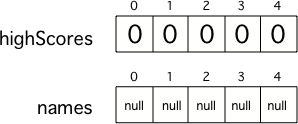
To create an empty array after declaring the variable, use the new keyword with the type and the size of the array (the number of elements it can hold). This will actually create the array in memory. You can do the declaration and the creation all in one step, see the String array names below. The size of an array is set at the time of creation and cannot be changed after that.
//declare an array variable
int[] highScores;
// create the array
highScores = new int[5];
// declare and create array in 1 step!
String[] names = new String[5];
In the following code, add another array declaration that creates an array of 5 doubles called prices and another array of 5 Strings called names and corresponding System.out.println commands.
Subsection6.21.3Initializer Lists to Create Arrays
Another way to create an array is to use an initializer list. You can initialize (set) the values in the array to a list of values in curly brackets { } when you create it, like below. In this case you don’t specify the size of the array, it will be determined from the number of values that you specify.
When you create an array of a primitive type (like int) with initial values specified, space is allocated for the specified number of items of that type and the values in the array are set to the specified values. When you create an array of an object type (like String) with initial values, space is set aside for that number of object references. The objects are created and the object references set so that the objects can be found.
Arrays know their length (how many elements they can store). It is a public read-only instance variable so you can use dot-notation to access the instance variable (arrayName.length). Dot-notation is using variable name followed by a . and then the instance variable (property) name or a method name. Try the following.
Try running the code below to see the length. Try adding another value to the highScores initializer list and run again to see the length value change.
Note that length is an instance variable and not a method, unlike the String length() method, so you don’t add parentheses after length. However, if you use parentheses after length during the exam, you won’t lose any points. The length instance variable is declared as a public final int. public means you can access it and final means the value can’t change.
Remember that the first element in an array starts at index 0. If the length (the number of elements) of the array is 5, at what index would you find the last element?
highScores.length - 1
Since the first element in an array is at index 0 the last element is the length minus 1.
To access the items in an array, we use an indexed array variable which is the array name and the index inside of square bracket [ ]. Remember that an index is a number that indicates the position of an item in a list, starting at 0.
An indexed variable like arrayname[index] can be used anywhere a regular variable can be used, for example to assign a new value or to get a value from the array like below.
// assign a new value 99 to the first element in the array
highScores[0] = 99;
// print the first element of the array
System.out.println( highScores[0] );
Note6.21.10.
The first value in an array is stored at index 0 and the index of the last value is the length of the array minus one (since the first index is 0). Use arrayname[index] to access or modify array items.
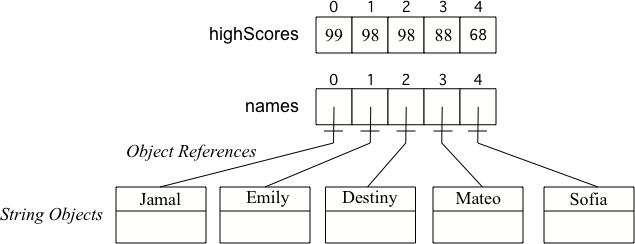
If you want to keep track of the top 5 highest scores in a game and the names of the people with those scores, you could use two parallel arrays. One array could keep track of the scores and the other the names. You have to make sure you keep them in the same order so that the same index can be used to get correponding names and scores.
Try out the following code which has two parallel arrays, highScores and names. Can you print out Mateo’s score? Can you change Sofia’s score to 97 using an assignment statement in the code? Can you change the arrays so that they have 6 elements and add your name and score and print them out?
What happens if you try to access an element that is not there? Try to access a highScore or name at index 7 above to see what happens. The index must be between 0 and the length of the array - 1 or it will give an error message called ArrayIndexOutOfBoundsException.
One powerful feature in the array data abstraction is that we can use variables for the index! As long as the variable holds an integer, we can use it as an index.
// use a variable for the index
int index = 3;
System.out.println(  highScores[index] );
Here’s a fun String array of image filenames. The following code displays an online image using an HTML tag. (Note that this just works in this Active Code window which interprets HTML. In other Java IDEs you would need to use Java Swing graphics instead). Run the code and see that it displays images[0] which is “cow.jpg”. The images array holds 5 images.
Can you change the index variable’s value so that it prints out the puppy image? Can you print out the reindeer? Try all of them! What indices did you need to use? Then try using a random number for the index instead. Remember that (int)(Math.random()*max) will return a number from 0 up to max. What’s the maximum number it can be for this array?
Square brackets ([ ]) are used to access and modify an element in an array using an index. The indexed array variable, for example array[index], can be used anywhere a regular variable can be used, for example to get or assign values.
The valid index values for an array are 0 through one less than the number of elements in the array, inclusive. Using an index value outside of this range will result in an ArrayIndexOutOfBoundsException being thrown.