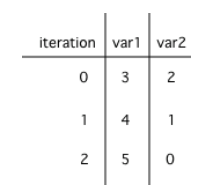
Let’s practice tracing through loops with many variables. Remember to make a tracing table to keep track of all the variables, the iterations, and the output.
Can you trace through this code? Add in output statements System.out.println("var1: " + var1 + " var2: " + var2); before the loop and inside the loop at the end to keep track of the variables and run. Click on the Code Lens button to visualize the code step by step.
int var1 = 0;
int var2 = 2;

while ((var2 != 0) && ((var1 / var2) >= 0))
{
   var1 = var1 + 1;
   var2 = var2 -1;
}
var1 = 1, var2 = 1
The loop stops one of two ways, when var2 = 0 or when var1 / var2 = 0 - neither is true in this case
var1 = 2, var2 = 0
The loop stopped because var2 = 0. After the first execution of the loop var1 = 1 and var2 = 1. After the second execution of the loop var1 = 2 and var2 = 0. This stops the loop and doesn’t execute the second part of the complex conditional.
var1 = 3, var2 = -1
The loop stops one of two ways, when var2 = 0 or when var1 / var2 = 0 - neither is true in this case
var1 = 0, var2 = 2
The loop stops one of two ways, when var2 = 0 or when var1 / var2 = 0 - neither is true in this case
The loop will cause a run-time error with a division by zero
Even though var1 = 2 and var2 = 0 when the conditional is executed the first condition is true so the rest of the complex conditional won’t execute.
int x = 2;
int y = 5;

while (y > 2 && x < y)
{
   x = x + 1;
   y = y - 1;
}
x = 5, y = 2
This would be true if the and (&&) was an or (||) instead. But in a complex conditional joined with and (&&) both conditions must be true for the condition to be true.
x = 2, y = 5
This would be true if the loop never executed, but both conditions are true so the loop will execute.
x = 5, y = 2
This would be true if the values were swapped, but they are not.
x = 3, y = 4
This would be true the loop only executed one time, but it will execute twice.
x = 4, y = 3
The first time the loop changes to x = 3, y = 4, the second time x = 4, y = 3 then the loop will stop since x is not less than y anymore.
If you made a trace table, you would know that the loop runs when i = 3, 4, 5, 6 but finishes as soon as i becomes 7 since that is not less than 7. So, the loop runs 4 times. Or you can use the shortcut formula in the note below.
In the code above the largest value that allows the loop to run is 6 (which is the largest value < 7) and the smallest value that allows the loop to execute is 3 so this loop executes (6 - 3 + 1 = 4 times).
The number of times a nested for loop body is executed is the number of times the outer loop runs multiplied by the number of times the inner loop runs (outer loop runs * inner loop runs).
The number of times a loop executes can be calculated by (largestValue - smallestValue + 1) where these are the largest and smallest values of the loop counter variable possible in the body of the loop.