
Activity 15.7.1.
Write a class APLine with instance variables, a constructor with 3 paramaters for a, b, c, and the methods getSlope() and isOnLine(x,y).
public class ClassName			// Class Header - Note no ()
{
    private type variableName1;		// Private instance variable(s)
    private type variableName2;

    public ClassName(type param1, ...)	// Constructor with parameters
    {
        variableName1 = param1;	// set private instance variables to parameters
        variableName2 = param2;
    }

    // Methods as requested
    public returnType methodName(type param, ...)
    {
        /* implementation will vary */
    }

    public type getVariableName1()	// Possibly a getter
    {
        return variableName1;
    }
}
APLine is a line defined by the equation ax + by + c = 0,where a is not equal to zero, b is not equal to zero, and a, b, and c are all integers. The slope of an APLine is defined to be the double value -a / b. A point (represented by integers x and y) is on an APLine if the equation of the APLine is satisfied when those x and y values are substituted into the equation. That is, a point represented by x and y is on the line if ax + by + c is equal to 0. Examples of two APLine equations are shown in the following table.

APLine. The code segment shows an example of using the APLine class to represent the two equations shown in the table.
APLine line1 = new APLine(5, 4, -17);
double slope1 = line1.getSlope();        // slope1 is assigned -1.25
boolean onLine1 = line1.isOnLine(5, -2); // true because 5(5) + 4(-2) + (-17) = 0

APLine line2 = new APLine(-25, 40, 30);
double slope2 = line2.getSlope();        // slope2 is assigned 0.625
boolean onLine2 = line2.isOnLine(5, -2); // false because -25(5) + 40(-2) + 30 != 0
APLine class. Your implementation must include a constructor that has three integer parameters that represent a, b, and c, in that order. You may assume that the values of the parameters representing a and b are not zero.
getSlope() that calculates and returns the slope of the line (using the equation -a / b) and a method isOnLine(x, y) that returns true if the point represented by its two parameters (x and y, in that order) is on the APLine and returns false otherwise, by testing if ax + by + c is equal to 0.
Scoreboard for a game. The game is played between two teams who alternate turns so that at any given time, one team is active and the other team is inactive. During a turn, a team makes one or more plays. Each play can score one or more points and the team’s turn continues, or the play can fail, in which case no points are scored and the team’s turn ends. The Scoreboard class, which you will write, is used to keep track of the score in a game.
recordPlay method has a single nonnegative integer parameter that is equal to the number of points scored on a play or 0 if the play failed. If the play results in one or more points scored, the active team’s score is updated and that team remains active. If the value of the parameter is 0, the active team’s turn ends and the inactive team becomes the active team. The recordPlay method does not return a value.
getScore method has no parameters. The method returns a String containing information about the current state of the game. The returned string begins with the score of team 1, followed by a hyphen ("-"), followed by the score of team 2, followed by a hyphen, followed by the name of the team that is currently active.
Scoreboard.
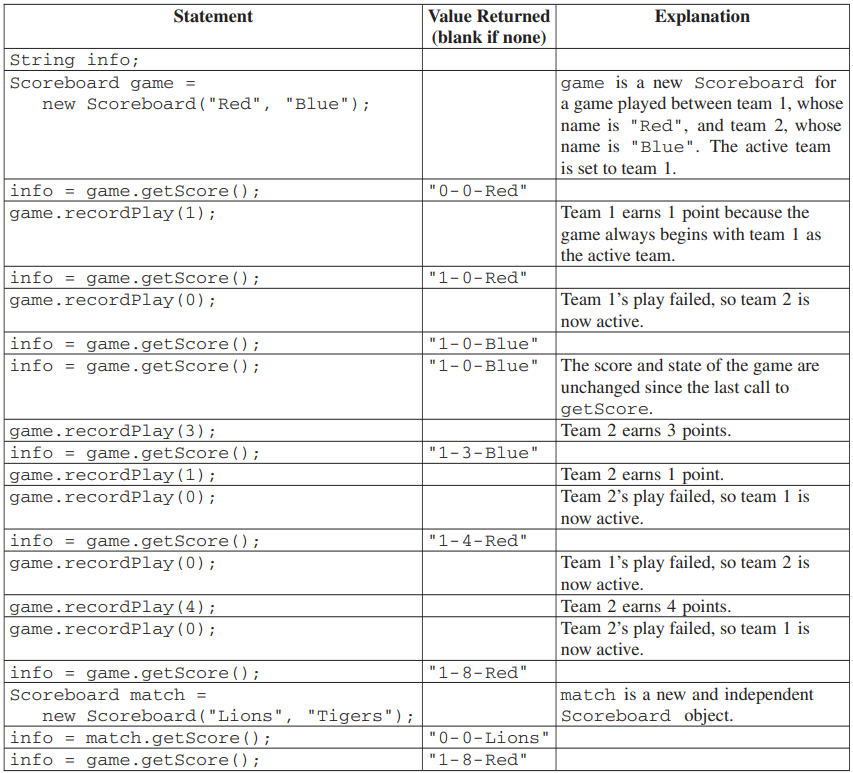
Scoreboard class. Your implementation must meet all specifications and conform to the examples shown in the preceding table.

