Logo image

Section 8.1 What is a Numerical Solution?

Most of what weโ€™ve done so far has been focused on finding exact solutions to differential equations, like \(y(t) = e^{-3t} \sin(2t)\text{.}\) This kind of solution is called an analytic solution, or sometimes a closed-form solution. It is valuable because it expresses \(y(t)\) as a formula-like structure that you can plug in any value of \(t\) and instantly get the exact \(y\) value.
However, many differential equations, such as
\begin{equation*} y' = e^{-y^2}, \quad y(0) = 0 \end{equation*}
simply do not have a tidy closed-form solution. In those cases, we switch tools. Instead of searching for an exact formula, we use a numerical method. A numerical method doesnโ€™t hand you \(y(t)\) as a formulaโ€”it builds an approximation, one step at a time, starting from what you know and using the differential equation to predict what happens next. The result is a numerical solution.
In this section, weโ€™ll explore what numerical solutions are, why theyโ€™re useful, and how they differ from analytic solutions. Understanding this distinction is essential for the computational methods weโ€™ll develop in later sections.

Subsection Analytic vs. Numerical Solutions

Checkpoint 101. ๐Ÿ“–โ“ Analytic Solution, AKA โ€ฆ.

What is another name for an analytic solution?
  • Closed-form solution
  • Yes, a closed-form solution is another name for an analytic solution.
  • Approximate solution
  • No, an approximate solution refers to a numerical solution.
  • Continuous solution
  • Not all analytic solutions are continuous, and not all continuous solutions are analytic.
  • Systematic solution
  • While you may solve analytically using a systematic process, this is not a name for an analytic solution.
To see the difference between analytic and numerical solutions, consider the initial value problem:
\begin{equation} y' = y, \quad y(0) = 1, \quad 0 \le t \le 2\tag{8.2} \end{equation}
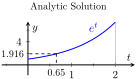
Analytically, this equation has the elegant solution:
\begin{equation*} y(t) = e^t\text{.} \end{equation*}
With this formula, you can calculate the exact value at any time. For example, \(t = 0.65\) gives
\begin{equation*} y(0.65) = e^{0.65} \approx 1.915540829...\text{.} \end{equation*}
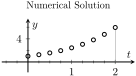
The same equation can also be solved numerically. Instead of a formula, we produce a table of \(t\)-values and approximate \(y\)-values:
\(t\) \(y(t)\) (approx)
0.00 1.0000
0.25 1.2500
0.50 1.5625
0.75 1.9531
โ€ฆ โ€ฆ
Plot the
points \(\rightarrow\)

Checkpoint 102. ๐Ÿ“–โ“ Recognizing a Numerical Solution.

When you say youโ€™ve found a โ€œnumerical solutionโ€ to an initial value problem, what do you actually have?
  • A list of values approximating \(y(t)\) at specific times
  • Correctโ€”numerical solutions are tables of approximate values, not formulas.
  • A formula expressing \(y(t)\) using functions like \(\sin t\) or \(e^t\)
  • No, that describes an analytic solution.
  • An exact solution valid for all \(t\)
  • No, numerical solutions are approximations.
  • A graph showing all possible solutions
  • No, that describes a slope field, not a numerical solution.
The analytic solution gives a smooth curve for every \(t\text{.}\) The numerical solution gives dotsโ€”a sequence of approximations. Connect those dots and you get a picture of the solutionโ€™s shape, even though no formula was found.

๐Ÿ“ 103. Precision vs Practicality.

Numerical solutions are approximations. They carry small errors, but in exchange, they let us handle equations that analytic methods canโ€™t touch. This trade-off between perfect precision and practical usefulness is at the heart of numerical methods.
Table 104. Analytic vs. Numerical Solution Summary
\(\textbf{Analytic Solutions}\)
\(\textbf{Numerical Solutions}\)
\(\textbf{Also Known As}\)
Closed-form solutions
Approximate solutions
\(\textbf{Looks Like}\)
\(y = \) formula in \(t\)
Table of \(t\) & \(y\) values
\(\textbf{Solution Values}\)
Exact
Approximate
\(\textbf{Solution Graph}\)
Curve
Points

Subsection Why Do We Need Numerical Methods?

At first glance, analytic solutions might seem โ€œbetterโ€ than numerical ones. But there are important reasons why numerical methods arenโ€™t just usefulโ€”theyโ€™re essential:
  1. Many equations simply donโ€™t have a closed-form solution.
  2. Even when they do, the formula might be so complicated itโ€™s impractical.
  3. Numerical methods are easier to tweak if the model or data changes.

Checkpoint 105. ๐Ÿ“–โ“ Why use numerical methods?

Which of the following are good reasons to use a numerical method?
  • They can approximate a solution when no closed-form solution exists.
  • Trueโ€”sometimes theyโ€™re the only option.
  • They can be automated on a computer.
  • Trueโ€”theyโ€™re ideal for computer simulations.
  • They are easier to adjust when the equation changes.
  • Trueโ€”numerical methods adapt easily to model tweaks.
  • They produce more accurate solutions than analytic methods.
  • Noโ€”analytic solutions are exact when they exist.
You have attempted of activities on this page.