Logo image

Section 7.2 Autonomous Equations

When the first-order differential equation (7.1) contains no explicit \(t\) terms, it reduces to:
\begin{equation} \frac{dy}{dt} = f(y).\tag{7.2} \end{equation}
This is called an autonomous differential equation.
“Autonomous” means “self-governing”. In these equations, the rate of change of \(y\) depends only on \(y\) itself, not on time \(t\text{.}\) The system’s behavior is determined entirely by its current state. Think of a spring: it pushes back the same way no matter the time of day. Only how far it’s compressed matters, not what time it is.

Subsection Slope Fields of Autonomous Equations

Autonomous equations have a distinctive look in their slope fields. Consider:
\begin{equation*} y' = y^2 - 1\text{.} \end{equation*}
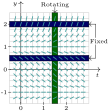
Here, the slope at any point \((t,y)\) depends only on \(y\text{.}\) Moving up or down (changing \(y\)) changes the slope, but sliding left or right (changing \(t\)) does not. The result is a “striped” slope field—each horizontal line has the same slope pattern all the way across.
Figure 85.(a) illustrates this. As you go up the plane, the slope segments gradually rotate, reflecting how \(f(y)\) changes with \(y\text{.}\) But moving sideways leaves the segments fixed—the slopes don’t shift with \(t\text{.}\)
(a) Rotating slope segments for changing \(y\) and fixed slope segments for changing \(t\)
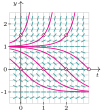
(b) Horizontal shift symmetry of solutions to autonomous differential equations
Figure 85. Symmetry in the slope field for \(y' = y^2 - 1\)
This symmetry isn’t just in the slope field; it shows up in the solutions themselves. As seen in Figure 85.(b), if you know one solution curve for an autonomous equation, you can create others simply by shifting that solution horizontally. That’s because the equation doesn’t “know” what time it is; it only cares about \(y\text{.}\)

Checkpoint 86. 📖❓ Autonomous Equations.

(a) 📖❓ What does a slope field represent?
Suppose you compute the slope of an autonomous differential equation to be \(3\) at the point \((2, 1)\text{.}\) What is the slope at \((-3, 1)\text{?}\)
  • \(0\)
  • This is incorrect. The slope depends only on \(y\text{,}\) not on \(t\text{.}\)
  • \(-3\)
  • This is incorrect. The slope function is \(f(y)\text{,}\) so \(t\) doesn’t affect the result.
  • \(1\)
  • No, remember that the slope at a point \((t, y)\) depends solely on \(y\text{.}\)
  • \(3\)
  • Correct. Since \(y = 1\) at both points, the slope is the same: \(f(1) = 3\text{,}\) regardless of \(t\text{.}\)
  • Impossible to answer.
  • This is incorrect. The value of \(f(y)\) is determined entirely by \(y\text{,}\) so this is answerable.
(b) 📖❓ Shifting Solutions.
Suppose \(y(t)\) is a solution to the autonomous equation \(y' = f(y)\text{.}\) Which of the following must also be a solution?
  • \(\ y(t + 3)\)
  • Exactly—autonomous equations ignore the clock. Shifting in time just slides the solution along the \(t\)-axis.
  • \(\ y(t) + 3\)
  • Adding to \(y\) changes the function itself—this doesn’t preserve the solution.
  • \(\ 3\ y(t)\)
  • Scaling \(y\) is not guaranteed to produce another solution unless the DE is linear, which this one may not be.
  • \(\ y(-t)\)
  • Flipping time is not generally a symmetry—it changes how \(y\) evolves.
You have attempted of activities on this page.