Logo image

Section 13.3 Piecewise Functions

Piecewise functions can feel disorganized at first since they are defined in separate β€œchunks” across different intervals. But there’s a powerful way to express them as a clean formula: by using step functions to switch each piece ON or OFF at the right time.

Subsection What Makes a Function Piecewise?

A piecewise function is any function built from different parts over specific regions of its domain. For example:
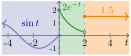
\begin{equation*} g(t)\ = \left\{ \begin{array}{ccccc} \DLBb \sin t, \amp \DLBb t \lt 0 \amp \\ \DLGa 2e^{-t}, \amp \DLGa 0 \le t \lt 2 \amp \longrightarrow\\ \DLO 1.5, \amp \DLO t \ge 2 \amp \end{array} \right. \end{equation*}
Each piece has its own behavior, but together they create the entire function. The question is: can we rewrite these separate pieces so that the whole function is described with one equation, instead of a case-by-case breakdown?

Subsection Thinking in Terms of Switches

Checkpoint 249. πŸ“–β“ Match Step Functions to Their Piecewise Definitions.

    By dragging from left to right, match the function on the left to the equivalent piecewise function on the right. Note that, \(u_0(t) = u(t)\text{.}\)
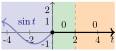
  • \begin{equation*} \big( 1 - u_0(t) \big) \sin t \end{equation*}
  • \(\left\{\begin{array}{ll} \sin t \amp t \lt 0\\ 0 \amp \text{otherwise}\end{array}\right.\)
  • \begin{equation*} \big( u_0(t) - u_6(t) \big) \sin t \end{equation*}
  • \(\left\{\begin{array}{ll} \sin t \amp 0 \le t \lt 6\\ 0 \amp \text{otherwise}\end{array}\right.\)
  • \begin{equation*} u_0(t) \sin t \end{equation*}
  • \(\left\{\begin{array}{ll} \sin t \amp t \ge 0\\ 0 \amp \text{otherwise}\end{array}\right.\)
  • \begin{equation*} \big( u_0(t) - 1 \big) \sin t \end{equation*}
  • \begin{equation*} \big( u_6(t) - u_0(t) \big) \sin t \end{equation*}
Every step function you’ve seen can be thought of as a simple ON–OFF switch:
\begin{equation*} \begin{array}{clllll} u_c(t) \amp\rightarrow\amp\text{ON:}\amp [c,\infty) \amp\text{OFF:}\amp\text{elsewhere}\\ u_c(t)-u_d(t) \amp\rightarrow\amp\text{ON:}\amp [c,d) \amp\text{OFF:}\amp\text{elsewhere}\\ 1 - u_c(t) \amp\rightarrow\amp\text{ON:}\amp (-\infty,c) \amp\text{OFF:}\amp\text{elsewhere} \end{array} \end{equation*}
With these step functions, you can literally β€œprogram” when each part of a function is ON and when it is OFF.
For example, the three pieces of \(g(t)\) above can be controlled like this:
\begin{equation*} \begin{array}{clllll} {\DLBb \sin t\ \big(1 - u_0(t)\big)} \amp\rightarrow\amp \sin t \amp\text{is ON:}\amp {\DLBb (-\infty,0)} \amp\text{OFF:}\amp\text{elsewhere}\\ {\DLGa 2e^{-t}\ \big(u_0(t) - u_2(t)\big)} \amp\rightarrow\amp 2e^{-t} \amp\text{is ON:}\amp {\DLGa [0,2)} \amp\text{OFF:}\amp\text{elsewhere}\\ {\DLO 1.5\ u_2(t)} \amp\rightarrow\amp 1.5 \amp\text{is ON:}\amp {\DLO [2,\infty)} \amp\text{OFF:}\amp\text{elsewhere} \end{array} \end{equation*}
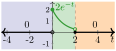
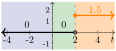
(a) \({\DLBb \sin t\ \big(1 - u_0(t)\big)}\)
(b) \({\DLGa 2e^{-t}\ \big(u_0(t) - u_2(t)\big)}\)
(c) \({\DLO 1.5\ u_2(t)}\)
Figure 250. Three pieces of \(g(t)\)

Subsection Rewriting a Piecewise Function in Step Form

Checkpoint 251. πŸ“–β“ Matching Step Types to Intervals.

FigureΒ 250 shows three non-overlapping regions. That means for any value of \(t\text{,}\) only one piece of the function is active. Because of this, we can write \(g(t)\) as a single sum:
\begin{equation*} g(t) = \sin t\ \big( 1 - u_0(t) \big) + 2e^{-t}\ \big( u_0(t) - u_2(t) \big) + 1.5\ u_2(t). \end{equation*}
Let’s test this step-function version by plugging in a few \(t\) values and seeing which terms turn ON and which turn OFF.
\begin{alignat*}{4} t=-2:\quad\amp g(-2) {}={} \amp\us{\large\text{ON}}{\ul{\sin(-2)\cdot\big(1\big)}}\amp {}+{} \amp\us{\large\text{OFF}}{\ul{2e^{2}\cdot\big(0\big)}}\amp {}+{} \amp\us{\large\text{OFF}}{\ul{1.5\cdot\big(0\big)}} {}={} \amp \sin(-2)\\ t=0: \quad\amp \hphantom{-}g(1) {}={} \amp\us{\large\text{OFF}}{\ul{\sin(0)\cdot\big(1\big)}}\amp {}+{} \amp\us{\large\text{ON}}{\ul{2e^{0}\cdot\big(1\big)}}\amp {}+{} \amp\us{\large\text{OFF}}{\ul{1.5\cdot\big(1\big)}} {}={} \amp 2e^{0}\\ t=1: \quad\amp \hphantom{-}g(2) {}={} \amp\us{\large\text{OFF}}{\ul{\sin(1)\cdot\big(1\big)}}\amp {}+{} \amp\us{\large\text{ON}}{\ul{2e^{-1}\cdot\big(1\big)}}\amp {}+{} \amp\us{\large\text{OFF}}{\ul{1.5\cdot\big(1\big)}} {}={} \amp 2e^{-1}\\ t=4: \quad\amp \hphantom{-}g(4) {}={} \amp\us{\large\text{OFF}}{\ul{\sin(4)\cdot\big(1\big)}}\amp {}+{} \amp\us{\large\text{OFF}}{\ul{2e^{-4}\cdot\big(1\big)}}\amp {}+{} \amp\us{\large\text{ON}}{\ul{1.5\cdot\big(1\big)}} {}={} \amp 1.5 \end{alignat*}
Like the piecewise form, plugging a specific \(t\) value into \(g(t)\) was the same as plugging it into just one of its three pieces. This observation explains why the unit-step form is equivalent to the piecewise form.

πŸ“œ Converting Piecewise Form to Unit Step Form.

Here’s a strategy for converting any piecewise function into step form:
  • Find the intervals where each piece is active.
  • Match the active interval for each piece to its step function switch:
    Piece Active Interval Step Function Switch
    \begin{equation*} P(t) \end{equation*}
    \begin{equation*} t \lt c \end{equation*}
    \begin{equation*} 1 - u_c(t) \end{equation*}
    \begin{equation*} Q(t) \end{equation*}
    \begin{equation*} c \le t \lt d \end{equation*}
    \begin{equation*} u_c(t) - u_d(t) \end{equation*}
    \begin{equation*} R(t) \end{equation*}
    \begin{equation*} t \ge d \end{equation*}
    \begin{equation*} u_d(t) \end{equation*}
  • Multiply the piece by its switch, then add them all together.

Checkpoint 252. πŸ“–β“ Which Term Matches the Interval?

You’re converting a piecewise function into step form. Which term below correctly captures a piece of the function that is active only for \(3 \le t \lt 6\text{?}\)
  • \(1 - u_3(t)\)
  • This turns ON before \(t = 3\) and OFF after. We want something that activates at \(t = 3\) and deactivates at \(t = 6\text{.}\)
  • \(1 - u_6(t)\)
  • This starts at \(t = 6\) and keeps going. It doesn’t define an interval; it defines a forever switch.
  • \(u_3(t) - u_6(t)\)
  • Exactly. This is the window function that’s ON from \(t = 3\) to \(t = 6\) and OFF otherwise.
  • \(u_6(t) - u_3(t)\)
  • Close, but this would result in \(-1\) on \(3 \le t \lt 6\text{,}\) not \(1\text{.}\) Try reversing the order of the terms.
Now you’re ready to try a few full conversions yourself.

🌌 Example 253. Using \(u_c(t)\) to Turn ON Sine.

Rewrite the function
\begin{equation*} g(t) = \left\{ \begin{array}{ll} \sin t, \amp t \ge \sfrac{\pi}{2} \\ 0, \amp \text{otherwise} \end{array} \right. \end{equation*}
using a unit step function.
Solution.
Since \(\sin t\) turns ON at \(t = \sfrac{\pi}{2}\text{,}\) we multiply it by \(u_{\sfrac{\pi}{2}}(t)\text{:}\)
\begin{equation*} g(t) = \sin t \cdot u_{\sfrac{\pi}{2}}(t) \end{equation*}
Plugging in \(u_{\sfrac{\pi}{2}}(t)\text{,}\) confirms we arrived at the correct piecewise function:
\begin{align*} g(t) = \sin t \cdot \ub{ \left\{ \begin{array}{ll} 1, \amp t \ge \sfrac{\pi}{2}\\ 0, \amp \text{otherwise} \end{array} \right. }_{\large u_{\sfrac{\pi}{2}}(t)} \quad \amp = \left\{ \begin{array}{ll} \sin(t) \cdot 1, \amp t \ge \sfrac{\pi}{2}\\ \sin(t) \cdot 0, \amp \text{otherwise} \end{array} \right.\\ \amp = \left\{ \begin{array}{ll} \sin(t), \amp t \ge \sfrac{\pi}{2}\\ 0, \amp \text{otherwise} \end{array} \right. \end{align*}
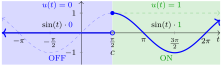
and has the following graph
Figure 254. Graph of \(\sin (t) \cdot u_{\sfrac{\pi}{2}}(t)\)

🌌 Example 255. Converting to Unit Step Form.

Rewrite the following piecewise functions using unit step notation:
\begin{equation*} P(t) = \left\{ \begin{array}{ll} e^{-t}, \amp t \lt 2.8 \\ 6 - t, \amp t \ge 2.8 \end{array} \right. \end{equation*}
\begin{equation*} Q(t) = \left\{ \begin{array}{ll} 2t, \amp 0 \le t \lt 1 \\ 3, \amp 1 \le t \lt 4 \\ 0, \amp t \ge 4 \end{array} \right. \end{equation*}
Solution 1. \(\rightarrow P(t)\)
The first piece is active before \(t = 2.8\text{,}\) so we use \(1 - u_{2.8}(t)\text{.}\) The second piece starts at \(t = 2.8\text{,}\) so we use \(u_{2.8}(t)\text{.}\) So:
\begin{equation*} P(t) = e^{-t} \cdot \left(1 - u_{2.8}(t)\right) + (6 - t) \cdot u_{2.8}(t) \end{equation*}
We can also combine terms with the same step:
\begin{align*} P(t) \amp = e^{-t} - e^{-t} \cdot u_{2.8}(t) + (6-t) \cdot u_{2.8}(t) \\ \amp = e^{-t} + \left(-e^{-t} + (6-t) \right) \cdot u_{2.8}(t) \text{.} \end{align*}
Solution 2. \(\rightarrow Q(t)\)
There are three pieces:
  • \(2t\) is ON from \(0 \le t \lt 1\) β†’ use \(u_0(t) - u_1(t)\)
  • \(3\) is ON from \(1 \le t \lt 4\) β†’ use \(u_1(t) - u_4(t)\)
  • \(0\) is ON for \(t \ge 4\) β†’ use \(u_4(t)\text{,}\) though it contributes nothing
Putting it together:
\begin{equation*} Q(t) = 2t \cdot \left(u_0(t) - u_1(t)\right) + 3 \cdot \left(u_1(t) - u_4(t)\right) \end{equation*}
Distribute and combine like unit step terms:
\begin{align*} Q(t) \amp = 2t \cdot u_{0}(t) - 2t \cdot u_{1}(t) + 3 \cdot u_{1}(t) - 3 \cdot u_{4}(t)\\ \amp = 2t\, u_0(t) + (3 - 2t)\, u_1(t) - 3\, u_4(t) \end{align*}
From here on out, we’ll use this compact step-function form whenever we need to handle piecewise forcing functions. This also unlocks the Laplace transform method for problems that contain piecewise forcing functions.

Checkpoint 256. πŸ€”πŸ’­ Piecewise Functions Reading Questions.

(a) πŸ€”πŸ’­ Piecewise to Laplace.
You have attempted of activities on this page.