
Activity 3.2.3.
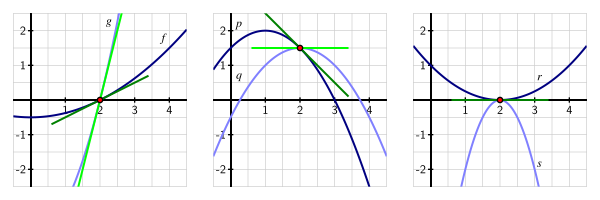
In this activity, we reason graphically from the following figure to evaluate limits of ratios of functions about which some information is known.
ADD ALT TEXT TO THIS IMAGE
(a)
Use the left-hand graph to determine the values of \(f(2)\text{,}\) \(f'(2)\text{,}\) \(g(2)\text{,}\) and \(g'(2)\text{.}\) Then, evaluate \(\lim\limits_{x \to 2} \frac{f(x)}{g(x)}\text{.}\)
(b)
Use the middle graph to find \(p(2)\text{,}\) \(p'(2)\text{,}\) \(q(2)\text{,}\) and \(q'(2)\text{.}\) Then, determine the value of \(\lim\limits_{x \to 2} \frac{p(x)}{q(x)}\text{.}\)
(c)
Assume that \(r\) and \(s\) are functions whose for which \(r''(2) \ne 0\) and \(s''(2) \ne 0\) Use the right-hand graph to compute \(r(2)\text{,}\) \(r'(2)\text{,}\) \(s(2)\text{,}\) \(s'(2)\text{.}\) Explain why you cannot determine the exact value of \(\lim\limits_{x \to 2} \frac{r(x)}{s(x)}\) without further information being provided, but that you can determine the sign of \(\lim\limits_{x \to 2} \frac{r(x)}{s(x)}\text{.}\) In addition, state what the sign of the limit will be, with justification.

