Logo image

Active Calculus 2nd Ed

Section 9.1 Review of Prerequsites for Calculus I

Exercises Exercises

1.

For each of the following pairs of lines, find the slope, \(m\text{,}\) through the points or if undefined, type undefined.
  1. \({\left(-10,-4\right)}\) and \({\left(-10,-9\right)}\)
    \(m=\)
  2. \({\left(-4,-10\right)}\) and \({\left(0,-3\right)}\)
    \(m=\)
  3. \({\left(-8,10\right)}\) and \({\left(8,10\right)}\)
    \(m=\)

2.

The equation of the line that goes through the points \(( -4 ,7 )\) and \(( 10 ,-10 )\) can be written in the form \(y = mx+b\) where
\(m =\) and \(b =\)

3.

Find all real numbers \(x\) which satisfy the equation.
\begin{equation*} 6 x^6 - 4 x^2 = 0 \end{equation*}
Answer:
Note: If there is more than one answer, write them separated by commas (e.g., 1, 2). Do not list individual values of \(x\) more than once.

4.

If \(f(x)=x^{2} +7\text{,}\) find and simplify the following:
(a) \(f(t+2) =\)
(b) \(f(t^5+2) =\)
(c) \(f(5) =\)
(d) \(5 f(t) =\)
(e) \((f(t))^2+2 =\)

5.

Express the equation in exponential form
(a) \(\log_{16} 2 = \frac{1}{4}\text{.}\)
That is, write your answer in the form \(A^B=C\text{.}\) Then
A=
B=
C=
(b) \(\log_2\frac{1}{16} = -4\text{.}\)
That is, write your answer in the form \(D^E=F\text{.}\) Then
D=
E=
F=

6.

The velocity (in ft/s) of a sky diver \(t\) seconds after jumping is given by
\begin{equation*} v(t) = 85 (1-e^{-0.1 t}) \end{equation*}
After how many seconds is the velocity 75 ft/s?
seconds

7.

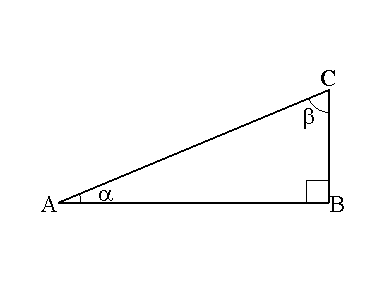
Refer to the right triangle in the figure. Click on the picture to see it more clearly.
If , \(BC=10\) and the angle \(\beta=70 ^\circ\text{,}\) find any missing angles or sides. Give your answer to at least 3 decimal digits.
AB =
AC =
\(\alpha\)=

8.

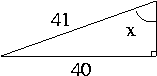
Click on the graph to view a larger graph
For the given angle \(x\) in the triangle given in the graph
\(\sin x=\) ;
\(\cos x=\) ;
\(\tan x=\) ;
\(\cot x=\) ;
\(\sec x=\) ;
\(\csc x=\) ;

9.

Solve the following equations in the interval [0,2\(\pi\)].
Note: Give the answer as a multiple of \(\pi\text{.}\) Do not use decimal numbers. The answer should be a fraction or an integer. Note that \(\pi\) is already included in the answer so you just have to enter the appropriate multiple. E.g. if the answer is \(\pi/2\) you should enter 1/2. If there is more than one answer enter them separated by commas.
\(\sin(t)= -\frac{\sqrt{2}}{2}\)
\(t=\) \(\pi\)
\(\sin(t)= -\frac{\sqrt{3}}{2}\)
\(t=\) \(\pi\)

10.

Solve the following equations in the interval [0, 2 \(\pi\)].
Note: Give the answer as a multiple of \(\pi\text{.}\) Do not use decimal numbers. The answer should be a fraction or an integer. Note that \(\pi\) is already included in the answer so you just have to enter the appropriate multiple. E.g. if the answer is \(\pi/2\) you should enter 1/2. If there is more than one answer enter them separated by commas.
\(\tan(t)=-{\sqrt{3}}\)
\(t =\) \(\pi\)
\(\tan(t)=-1\)
\(t =\) \(\pi\)
You have attempted of activities on this page.