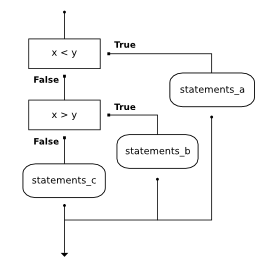
Python provides an alternative way to write nested selection such as the one shown in the previous section. This is sometimes referred to as a chained conditional.
elif is an abbreviation of else if. Again, exactly one branch will be executed. There is no limit of the number of elif statements but only a single (and optional) final else statement is allowed and it must be the last branch in the statement.
Each condition is checked in order. If the first is false, the next is checked, and so on. If one of them is true, the corresponding branch executes, and the statement ends. Even if more than one condition is true, only the first true branch executes.
# nested if-else statement
x = -10
if x < 0:
    print("The negative number ",  x, " is not valid here.")
else:
    if x > 0:
        print(x, " is a positive number")
    else:
        print(x, " is 0")
I.

if x < 0:
    print("The negative number ",  x, " is not valid here.")
else x > 0:
    print(x, " is a positive number")
else:
    print(x, " is 0")
II.

if x < 0:
    print("The negative number ",  x, " is not valid here.")
elif x > 0:
    print(x, " is a positive number")
else:
    print(x, " is 0")
III.

if x < 0:
    print("The negative number ",  x, " is not valid here.")
if x > 0:
    print(x, " is a positive number")
else:
    print(x, " is 0")
I only
You can not use a Boolean expression after an else.
II only
Yes, II will give the same result.
III only
No, III will not give the same result. The first if statement will be true, but the second will be false, so the else part will execute.
II and III
No, Although II is correct III will not give the same result. Try it.
I, II, and III
No, in I you can not have a Boolean expression after an else.