Section 3.2 Investigation 1.8: Halloween Treat Choices
Obesity has become a widespread health concern, especially in children. Researchers believe that giving children easy access to food increases their likelihood of consuming extra calories.

Schwartz, Chen, and Brownell (2003) examined whether children would be willing to take a small toy instead of candy at when trick-or-treating on Halloween. They had seven homes in 5 different towns in Connecticut present children with a plate of 4 toys (stretch pumpkin men, large glow-in-the-dark insects, Halloween theme stickers, and Halloween theme pencils) and a plate of 4 different name brand candies (lollipops, fruit-flavored chewy candies, fruit-flavored crunchy wafers, and "sweet and tart" hard candies) to see whether children were more likely to choose the candy or the toy. The houses alternated whether the toys were on the left or on the right. Data were recorded for 284 children between the ages of 3 and 14 (who did not ask for both types of treats).
Checkpoint 3.2.1. Identify Sample and Variable.
Checkpoint 3.2.2. Define Parameter.
Define (in words) the parameter of interest in this study.
Checkpoint 3.2.3. State Hypotheses.
Hint.
Checkpoint 3.2.4. Predict Distribution.
What does "theory" predict for the mean and standard deviation of the distribution of "number of successes" under the null hypothesis if we model this experiment as a binomial process? Do you expect this distribution to be symmetric and "filled in" or skewed and "gappy"?
Hint.
Solution.
Mean: \(n\pi = 284(0.5) = 142\)
Standard deviation: \(\sqrt{n\pi(1-\pi)} = \sqrt{284(0.5)(0.5)} = \sqrt{71} \approx 8.43\)
Because the sample size is large and \(\pi = 0.5\text{,}\) we expect the distribution to be symmetric and "filled in" (approximately normal).

The normal distribution has many, many applications to quantitative variables in general (e.g., many biological variables like height are assumed to follow a normal distribution). For now, we will focus on using this mathematical model as an approximation to the null distribution.
Central Limit Theorem.
If the sample size is large enough, then the distribution of "number of successes" for a binomial random variable will be well-modeled by the normal probability distribution. The sample size is considered large enough if \(n\times\pi\geq 10\) and \(n\times(1-\pi)\geq 10\text{.}\)
Checkpoint 3.2.5. Process Probability and Sample Size.
Why does the value of the process probability (\(\pi\)) matter when we check this condition?
Solution.
When \(\pi\) is close to 0 or 1, the binomial distribution becomes more skewed. We need both \(n\pi\) and \(n(1-\pi)\) to be large enough to ensure the distribution is symmetric enough to be well-approximated by a normal distribution. If \(\pi\) is very small, even with a large \(n\text{,}\) we might not have enough expected successes for the normal approximation to work well.
Checkpoint 3.2.6. Check Validity Conditions.
Does the Central Limit Theorem appear applicable for the Halloween study?
Checkpoint 3.2.7. Verify with Applet.
Use the One Proportion Inference applet to verify your answers to Checkpoint 3.2.4. Check the Normal Approximation box to verify your answer to Checkpoint 3.2.6.

There are actually some nice advantages to using the normal distribution rather than the binomial distribution, though less so as computers have become so advanced. For one, tail probabilities can be approximated by finding the area under the normal curve rather than summing binomial probabilities.
Finding a p-value with the normal approximation.
Checkpoint 3.2.8. Find p-values.
Solution.
With 135 children choosing the toy (fewer than expected under \(H_0\)):
Simulation: Approximately 0.40 (will vary) - found by simulating many samples from a binomial distribution and counting the proportion as extreme or more extreme than 135.
Exact binomial: Approximately 0.40 - found by calculating \(P(X \leq 135) + P(X \geq 149)\) using the binomial distribution.
Normal approximation: Approximately 0.40 - found by calculating the area under the normal curve below 135 and above 149.

The normal approximation is typically applied to the null distribution of sample proportions rather than sample counts.
Checkpoint 3.2.9. Switch to Proportions.
Use the radio button to toggle the Choice of Statistic to Proportion of heads. What changes about the null distribution? What is the observed value of the statistic?
Solution.
Key Result.
When the Central Limit Theorem applies, the distribution of sample proportions is approximately normal with mean equal to \(\pi\) and standard deviation equal to \(SD(\hat{p}) = \sqrt{\pi(1-\pi)/n}\text{.}\)
When we are using the normal distribution, it is even more common to work with the "standardized statistic" by calculating how many standard deviations the statistic is from the expected value (mean) of the null distribution.
Checkpoint 3.2.10. Calculate Standardized Statistic.
Standardize the value of the statistic for the Halloween study by comparing to the mean and standard deviation of the distribution of sample proportions. Interpret your result in context.
Standardized statistic \(z = \frac{\text{observed statistic} - \text{expected value}}{SD \text{ of statistic}} = \)
Interpretation:
(What if we had used the sample count instead?)
Definition.
The One Proportion z-test calculates the standardized statistic as \(z_0 = \frac{\hat{p} - \pi_0}{\sqrt{\pi_0(1-\pi_0)/n}}\) and uses the standard normal distribution (mean 0, std dev 1) to find the p-value.
Checkpoint 3.2.11. Interpret Subscript Notation.
What does the "zero" subscript tell you?
Key Result.
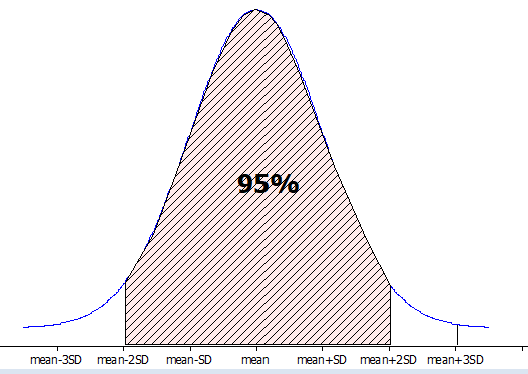
In any normal distribution with mean \(\mu\) and standard deviation \(\sigma\text{,}\) we expect the interval \((\mu - 2\sigma, \mu + 2\sigma)\) to capture approximately 95% of the distribution. In other words, 95% of sample proportions should fall within \(2 \times \sqrt{\pi(1-\pi)/n}\) of \(\pi\text{.}\) So with a normal distribution, the two-standard deviation guideline matches up with a two-sided p-value below 0.05.
Checkpoint 3.2.12. Draw Conclusion.
What do you conclude about the plausibility of the null hypothesis based on this standardized statistic?
Checkpoint 3.2.13. Calculate p-value from z-statistic.
Use technology to find the corresponding p-value. [Hints: You can calculate the probability from the z-value using standard normal distribution (mean 0, SD 1), e.g., Normal Probability Calculator applet; or use the Technology Detour below to carry out a one-sample z-test.]
p-value =
Technology Detour - One Proportion z-test.
Checkpoint 3.2.14. Technology Detour (Theory-Based Inference Applet).
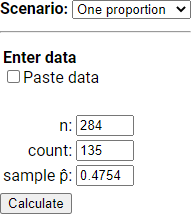
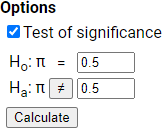
Use the Theory-Based Inference applet to conduct a one proportion z-test:
Hint.
Solution.
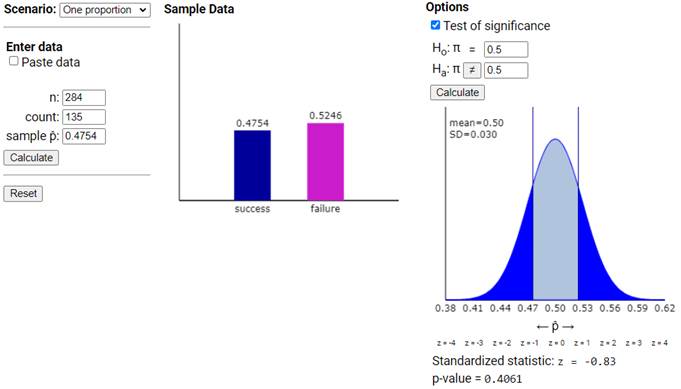
The applet will display:
-
Sample statistic: \(\hat{p} = 0.475\)
-
Standardized statistic: \(z \approx -0.84\)
-
Two-sided p-value: approximately 0.40
-
A normal curve with the shaded rejection regions
The applet confirms that there is not strong evidence against the null hypothesis that children choose equally between toys and candy.
Checkpoint 3.2.15. Technology Detour (R).
Use R to conduct a one proportion z-test. The
iscamonepropztest(observed, n, hypothesized, alternative) function takes the following inputs:
-
observed = the observation of interest (count or proportion)
-
n = the sample size
-
hypothesized = the hypothesized process probability (\(\pi\))
-
alternative = "below," "above," or "two.sided"
Hint.
Solution.
Running the command:
library(iscam)
iscamonepropztest(135, 284, 0.5, "two.sided")
Should produce output including:
The function will also display a graph showing the standard normal distribution with the test statistic and shaded p-value region.

R output showing one proportion z-test results with standard normal curve and shaded p-value regions
Checkpoint 3.2.16. Technology Detour (JMP).
Using the ISCAM Journal file in JMP, select Hypothesis Test for One Proportion:
-
Use Raw Data or Summary Stats
-
Remember to specify a direction for the alternative, a hypothesized proportion, and a significance level (e.g., .05)
Hint.
Solution.
JMP will display a comprehensive output including:
-
Sample proportion: 0.475
-
Standard error: 0.0297
-
z-statistic: -0.84
-
Two-sided p-value: 0.40
-
A visual representation of the test
The output will indicate that we fail to reject the null hypothesis at the 0.05 significance level.

JMP output showing one proportion z-test results with test statistics and visual representation
Checkpoint 3.2.17. Interpret p-value.
Provide a one sentence interpretation of this p-value in context.
Hint.
Checkpoint 3.2.18. Evaluate Research Implications.
Do you think the researchers are pleased by the lack of significance in this test? Explain, in the context of the study, why such a result might be good news for them.
Hint.
Solution.
Yes, the researchers should be pleased! The lack of significance means there’s no strong evidence that children prefer candy over toys. This is good news because it suggests that offering toys as an alternative to candy is viable - children are willing to accept toys instead of candy. If there had been strong evidence of a preference for candy, it would suggest that offering toys wouldn’t be an effective strategy to reduce candy consumption.
Improving the normal approximation.
Even though we passed the "validity conditions" for the normal approximation for this study, we could still use a "continuity correction" to improve the approximation.
Checkpoint 3.2.19. Compare p-values.
Which p-value from the earlier comparison (exact binomial or normal approximation) is closer to your simulated p-value? Is this expected?
Checkpoint 3.2.20. Compare Discrete and Continuous.
In the binomial distribution \(P(X = 135) = 0.220\text{.}\) What is \(P(X = 135)\) with the normal distribution? How do \(P(X < 135)\) and \(P(X \leq 135)\) compare in each distribution?
Solution.
With the normal distribution (continuous), \(P(X = 135) = 0\) because the probability of any exact value is 0 for a continuous distribution.
In the binomial distribution (discrete): \(P(X \leq 135) = P(X < 135) + P(X = 135)\text{,}\) so these are different values.
In the normal distribution (continuous): \(P(X \leq 135) = P(X < 135)\) because \(P(X = 135) = 0\text{.}\)
To make the normal probability (which is finding \(P(X < 135)\)) closer to the binomial probability, which finds \(P(X \leq 135) = P(X < 135) + P(X = 135)\text{,}\) we want to include more of the area under the normal curve above 135 in our calculation. A continuity correction does this by using the normal distribution to find \(P(X < 135.5)\) instead. This does not change the binomial probability but should enlarge the normal probability.
Checkpoint 3.2.21. Apply Continuity Correction.
In the One Proportion Inference applet, specify 135.5 in the As Extreme As box (if using number of successes as the statistic, otherwise use \(135.5/284 \approx 0.477\) instead) and press Count. What does the applet use for the right-side cut-off? Why? How does the p-value change? Is it now more similar to the binomial p-value?
Solution.
The applet uses 148.5 for the right-side cut-off. This is because 135.5 is 6.5 below the mean of 142, so by symmetry, we need 6.5 above the mean: \(142 + 6.5 = 148.5\text{.}\)
The p-value should increase slightly (become closer to 0.40) and should now be more similar to the exact binomial p-value. The continuity correction improves the normal approximation by accounting for the fact that the normal distribution is continuous while the binomial is discrete.
Many software programs allow you to apply this continuity correction for a one-sample z-test (e.g., using \(\hat{p} = (X \pm 0.5)/n\) as the input) or may do so by default. However, when n is large, you may not see much difference in the values.
Technology Detour - Continuity Correction.
Checkpoint 3.2.22. Technology Detour (Theory-Based Inference Applet).
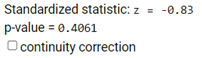
Hint.
Solution.
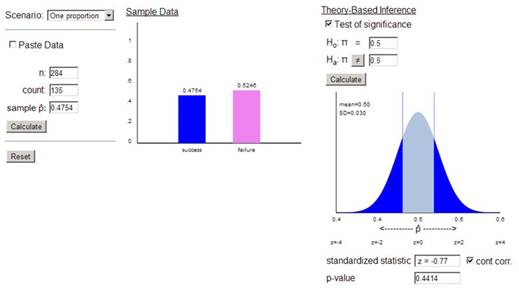
With the continuity correction applied:
-
The p-value changes from approximately 0.4061 to 0.4382
-
This is much closer to the exact binomial p-value of 0.4405
-
The continuity correction adjusts for the fact that we’re using a continuous distribution (normal) to approximate a discrete distribution (binomial)
Checkpoint 3.2.23. Technology Detour (R).
The
iscambinomnorm(k, n, prob, direction) function gives a visual of the continuity correction. It takes the following inputs:
-
k = the observation of interest
-
n = the sample size
-
prob = the process probability (\(\pi\))
-
direction = "below," "above," or "two.sided"
Solution.
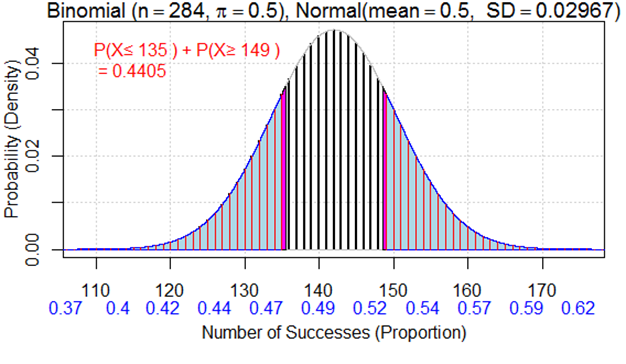
Running the command:
library(iscam)
iscambinomnorm(135, 284, 0.5, "two.sided")
This function creates a graph showing:
-
The binomial distribution (bars)
-
The normal approximation (curve)
-
The continuity correction boundaries at 135.5 and 148.5
-
The corrected p-value of approximately 0.4382
The visualization clearly shows how the continuity correction includes more area under the normal curve to better match the binomial probabilities.
Study Conclusions.
If we define \(\pi\) to be the probability that, when presented with a choice of candy or a toy while trick-or-treating, a child chooses the toy, and if we assume the null hypothesis (\(H_0: \pi = 0.5\)) is true, the above calculations tell us that we would observe at most 135 children choosing candy (or at least 149 choosing toy) or at most 135 of the 284 children choosing the toy in about 40% of all possible samples from such a process. Thus, this is not a surprising outcome when \(\pi = 0.5\text{.}\) We fail to reject the null hypothesis and conclude that it’s plausible that children are equally likely to choose the toy or the candy.
We do have some cautions with this study as it was conducted in only a few households in Connecticut, a "convenience sample," so we cannot claim that these results are representative of children in other neighborhoods. We also don’t know if the children found the toys "novel" and whether their preference for toys could decrease as the novelty wears off (or if "better" candy choices were offered). Furthermore, when the children approached the door they were asked their age and gender, and for a description of their Halloween costume. The researchers caution that this may have cued the children that their behavior was being observed (even though their responses were recorded by another research member who was out of sight) or that they should behave a certain way. Still, these researchers were optimistic that alternatives could be presented to children, even at Halloween, to lessen their exposure to large amounts of candy.
Subsection 3.2.1 Practice Problem 1.8A
In Investigation 1.6, Dr. Güntürkün conjectured that 2/3 of kissing couples lean right.
Checkpoint 3.2.24. Normal Approximation Validity.
Would the normal approximation (Central Limit Theorem) be valid for the kissing study in Investigation 1.6? Justify your answer.
Checkpoint 3.2.25. z-test and p-value.
Dr. Güntürkün found 80 out of 124 couples leaned right in his sample. Find the one-proportion z-test statistic and normal-based two-sided p-value. Do the standardized statistic and p-value agree? How does the normal-based p-value compare to the exact binomial p-value for this study?
Checkpoint 3.2.26. Continuity Correction.
Repeat the previous calculation using the continuity correction and compare the results.
Subsection 3.2.2 Practice Problem 1.8B
A student wanted to assess whether her dog Muffin tends to chase her blue ball and her red ball equally often when they are rolled at the same time. The student rolled both balls a total of 96 times, each time keeping track of which ball Muffin chased. The student found that Muffin chased the blue ball 52 times and the red ball 44 times. Let’s treat the blue ball as "success."
Checkpoint 3.2.27. State Hypotheses.
State the appropriate null and alternative hypotheses in symbols. (Be sure to describe what the symbol represents in this context.)
Checkpoint 3.2.28. Calculate Test Statistic.
Report and interpret the values of the z-test statistic and normal-based p-value using a continuity correction.
Checkpoint 3.2.29. Conclusion.
Summarize your conclusion about the student’s question concerning her dog Muffin.
Checkpoint 3.2.31. Alternate Definition.
How would your answers to the previous questions change if we had used the red ball as success?
You have attempted of activities on this page.

